For most people asking this question in Petaluma, CA, the answer is BLS. Basic Life Support covers CPR, AED use, and choking response for adults, children, and infants, and it’s the entry-level certification behind most healthcare, dental, childcare, and school jobs. ACLS and PALS sit on top of that foundation and only apply if your role involves advanced cardiac care or pediatric acute care. This guide walks through how to tell which one applies to you, without wading through certification jargon that doesn’t apply to your actual job.
Key takeaway: If you provide direct patient care without managing advanced cardiac or pediatric emergencies, BLS is almost certainly your certification. If your unit treats adult cardiac arrest or pediatric critical care, you likely need ACLS or PALS in addition to BLS, and your employer should confirm exactly which one.
Start Here: Match Your Situation to a Certification
Before reading further, see which of these fits your role:
- You’re a nurse, medical assistant, dental hygienist, EMT, or nursing student — BLS is very likely your requirement, since it’s the standard for direct patient-care positions.
- You work in an ICU, emergency department, telemetry unit, or cath lab treating adults — you likely need ACLS in addition to BLS.
- You work with infants or children in a clinical setting, such as a NICU, PICU, pediatric clinic, or school health office — PALS is the relevant advanced course.
- You’re a teacher, coach, childcare worker, fitness professional, or parent — BLS alone typically covers what you need, since ACLS and PALS are built for advanced clinical response.
- You’re not sure which department or unit you’ll be assigned to — ask your hiring manager or program coordinator before enrolling, since guessing can mean retaking a course later.
What Each Course Actually Prepares You For
BLS teaches the fundamentals: high-quality chest compressions, rescue breathing, AED operation, and clearing an airway obstruction. It’s designed to be usable by nearly anyone in direct patient contact, regardless of specialty.
ACLS adds structured management of adult cardiac arrest, stroke, and acute coronary events, including medication protocols and coordinated team roles during a resuscitation. It assumes BLS-level CPR skills are already solid and builds clinical decision-making on top of them.
PALS applies that same advanced framework to infants and children, with an emphasis on catching respiratory distress and shock before a child progresses to cardiac arrest. Pediatric emergencies typically unfold differently than adult ones, which is why PALS exists as a separate course rather than a shorter version of ACLS.
Where the Decision Gets Less Obvious
A few situations trip people up more than the basic role-to-course matching above.
Cross-coverage roles. A nurse who floats between a general medical floor and the ED may need both BLS and ACLS current at once. If that’s your situation, BLS should be completed first, since ACLS courses build directly on it rather than reteaching CPR basics.
Mixed adult-and-pediatric units. Some Sonoma County clinics and urgent care settings treat both adult and pediatric patients. In that case, a provider may need ACLS and PALS together, which is worth confirming with a supervisor rather than assuming one course covers both populations.
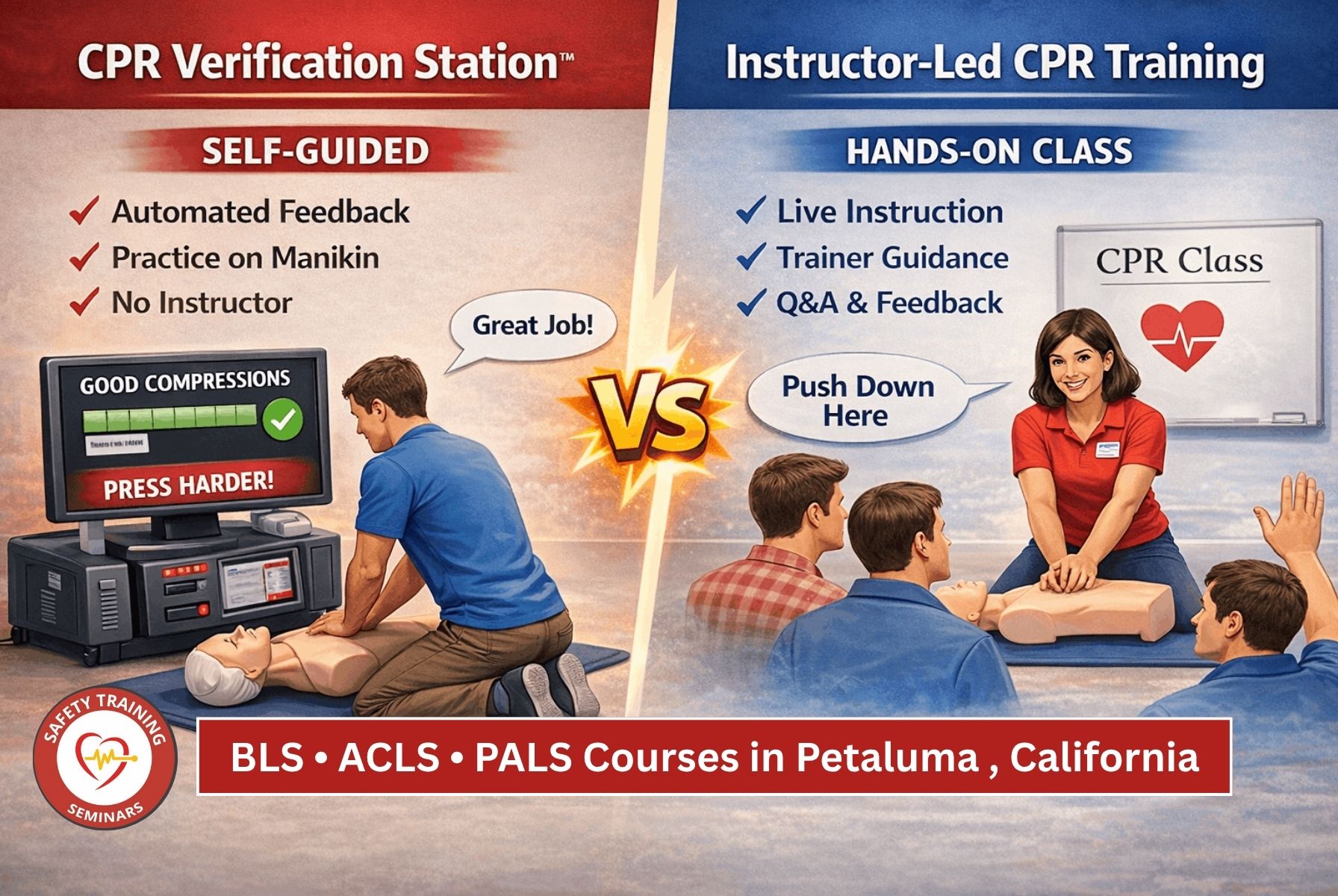
Online-only certificates. A card issued without any in-person or supervised skills verification is generally not accepted by hospitals, clinical programs, or licensing boards, since hands-on technique can’t be confirmed remotely. Most current courses use a blended format instead, pairing online coursework with an in-person skills check.
What to Expect During a Class Session
A typical BLS, ACLS, or PALS session combines instruction with hands-on skills practice, followed by a skills check where students demonstrate compressions, AED use, and, for ACLS and PALS, team-based scenario response. Students taking the blended format complete the cognitive material online beforehand and arrive for the in-person portion already familiar with the core concepts, which usually shortens the time spent in the classroom itself.
Bring comfortable clothing you can kneel and move in, since compression practice is done on the floor or a low table. If you’re renewing, having your current card on hand can help confirm your renewal timeline, though your employer’s specific renewal window is something to verify with them directly rather than assume.
Sonoma County’s Workforce Shapes Which Course Gets Used Most
Petaluma sits at the center of a Sonoma County healthcare and workforce mix that includes Petaluma Valley Hospital, nursing and allied-health students connected to regional community college programs, and a sizable dairy and agricultural employment base that runs its own workplace safety training. That mix means BLS is by far the most commonly requested certification locally, since it covers hospital support staff, dental offices, childcare centers, and general workplace safety teams alike. ACLS and PALS requests tend to come from a narrower group tied to hospital units and pediatric-focused clinics.
Students and professionals from around the region often compare scheduling across nearby cities rather than sticking to one location, including options in Santa Rosa and Sonoma when a different day or time works better. Rohnert Park, Cotati, Healdsburg, and Windsor residents frequently make the same comparison, since Highway 101 keeps most of these North Bay training options within a manageable drive of each other.
Finding a Local Class in Petaluma
Safety Training Seminars operates a training center in Petaluma at 921 Transport Way, Suite 30, Petaluma, CA 94954, offering BLS, ACLS, PALS, NRP, and First Aid course options. If BLS is your answer after working through the scenarios above, the Petaluma BLS CPR certification course page is the most direct starting point for checking current class availability before you register.
For anyone whose schedule points toward a different city, the Sebastopol and Windsor course pages cover those local options as well. Whichever location you choose, confirm the exact course, format, and any renewal timing with the training center directly, and separately confirm with your employer or school which certification your specific role requires.
Frequently Asked Questions
How do I know for sure whether I need BLS, ACLS, or PALS? Your job description or direct supervisor is the most reliable source, since requirements vary by unit, employer, and sometimes by licensing board. As a general pattern, direct patient-care roles use BLS, adult critical-care units use ACLS, and pediatric-focused roles use PALS. When your assignment isn’t clear yet, ask before registering rather than guessing.
Can I take ACLS or PALS without having BLS first? Most training providers expect current BLS-level CPR proficiency before ACLS or PALS, since those courses build on that foundation rather than reteaching it. Some allow enrollment without a separate BLS card if you can demonstrate the skills, but this varies by provider. Confirm the specific prerequisite before signing up.
Is an online-only BLS certificate accepted by Petaluma-area employers? Generally, no. Most hospitals, clinics, and clinical programs require a supervised, in-person skills check in addition to any online coursework, since hands-on technique can’t be verified remotely. A blended format that includes an in-person skills session is more commonly accepted than a fully online certificate.
Do I have to take my course in Petaluma, or can I attend a nearby city instead? A valid certification is generally accepted regardless of which city the course was completed in, as long as it comes from a recognized provider in a format your employer accepts. Sonoma County residents often compare Petaluma against nearby options in Santa Rosa or Sonoma based on scheduling rather than location requirements.
How often do I need to renew BLS, ACLS, or PALS? Renewal timing is typically set by your employer, licensing board, or school program rather than a single universal rule, so it’s worth confirming your specific renewal window directly with them. Keeping track of your current card’s expiration date is the simplest way to avoid a lapse that could affect a clinical assignment or job requirement.
Making Your Decision
If you’re still weighing which course to take, the fastest path is matching your actual patient population and unit to the scenarios outlined above, then confirming with your employer or program before you register. BLS covers the large majority of roles searching for certification in Petaluma, while ACLS and PALS apply to more specific adult and pediatric acute-care settings. Once you know which course fits, checking current availability at a local training center — including the options through Safety Training Seminars in Petaluma — is a practical next step toward getting scheduled without unnecessary delay.